
Limits and Continuity: When to use Factoring or Conjugates.
Introduction
Whenever you evaluate a limit, the very first question should be: Can I simply substitute the x-value into the function?
If the answer is yes, you’re finished. If not, then best practice is to first observe and identify the type of function it is and determine what prevents it from being evaluated directly, such that the denominator ends up equal to zero (0). However, if we manage to eliminate the obstacle and simplify the function, then we can evaluate the limit. So your job is to identify what this obstacle is and choose the correct method to remove it.
In this tutorial article we will discuss two techniques that address this problem, and when to use it. But first, let’s go over the different math ‘scenarios’ that makes a function face discontinuity.
In the beginning of your Calculus I class, which deals primarily with limits (), you will learn several different methods to use and tackle the problem when a function becomes undefined at a given limit. The difficulty is often not to $find$ the limit, but to efficiently discern what method to use and how to make the obstacle removable. I will here go over a few examples when to apply an algebraic method to eliminate a zero in the denominator, and thus make the limit possible to evaluate, as can be seen in figure 1. The types of functions that can make it discontinuous and therefore the limit Does Not Exist (DNE) are the following:
- Rational functions: If the denominator is defined such that for a certain x it renders a zero value, because .
- Even Root functions: because the function, for n = even , must satisfy . We don’t use imaginary numbers in this Calculus.
- Trigonometric functions that are Rational functions:
- Logarithmic functions:. Remember, for Logs we can have, for example, x=0.000000000001, but NOT exactly at x = 0 or less.
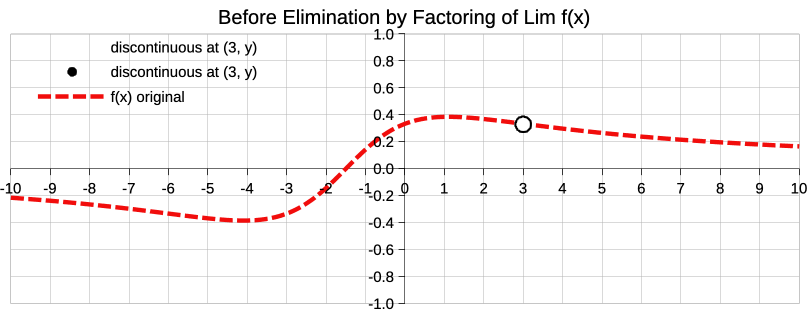
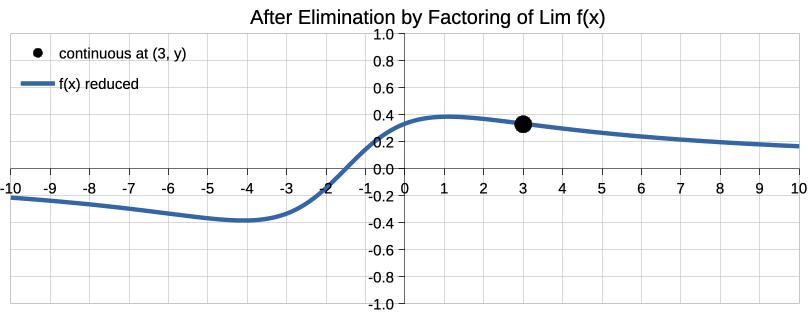
Before solving any limit.
Before you dive into solving a problem, ask yourself if the function is obviously continuous or if it at any point becomes discontinuous for a given limit . So ask yourself “Does the function have any restrictions?” and if so, ask “What condition of the ones listed above, applies?” Once this is determined, what method should you use?
a) Can you do direct Substitution?
b) Solve it algebraically by using cancellations/eliminations after factoring?
c) Create a common factor by multiplying with a conjugate?
In this article we’ll focus on functions of type 1 and 2 (listed in section 1.0) and use algebraic methods by either factor and eliminate common factors or create a common factor by multiplying with a conjugate AND learning to look at a function and immediately (hopefully) recognizing which algebraic tool fits the pattern.
Applying Factoring as the algebraic method.
In both your Algebra I and Algebra II classes you have done a substantial amount of factoring using a variety of methods. You are probably thinking that since you’re now finally in Calculus, you can put all that pesky factoring behind you …. sorry not so at all !! Remembering all methods is key to be successful in any math class moving forward. You had factor by grouping, completing the square plus a few other methods for quadratic functions. You also had cubic functions and their factoring ‘system’. So I will here do a few different examples that are a bit tricky to help you recognize what to do.
Consider the following problem that is graphed in figure 1:
$$\lim_{x \to 3}\frac{2x^2 – 3x -9}{x^3 – 27} \;\;\text{(Example 1) }$$
There’s clearly a denominator here, and if you use direct substitution, which you should alway check first and justify in your answer why it doesn’t work, we see that when substituting in 3 in the denominator and cubing it we get , which makes the function undefined and discontinuous, so the limit does not exist for . The next step is to identify if it can be easily reduced … hrmf … not so exactly with this one because the leading coefficient in the quadratic numerator is not 1 and the denominator is a cubic expression. A function like this is fully ‘legal’ and you should expect your professor to assign these as homework, and show up on your tests!
So let’s solve this problem by following the initial steps listed the introduction. Are you able to detect what to do? At first glance this problem may look intimidating. But instead of trying to solve everything at once, we will examine the numerator and denominator separately.
STEP 1)
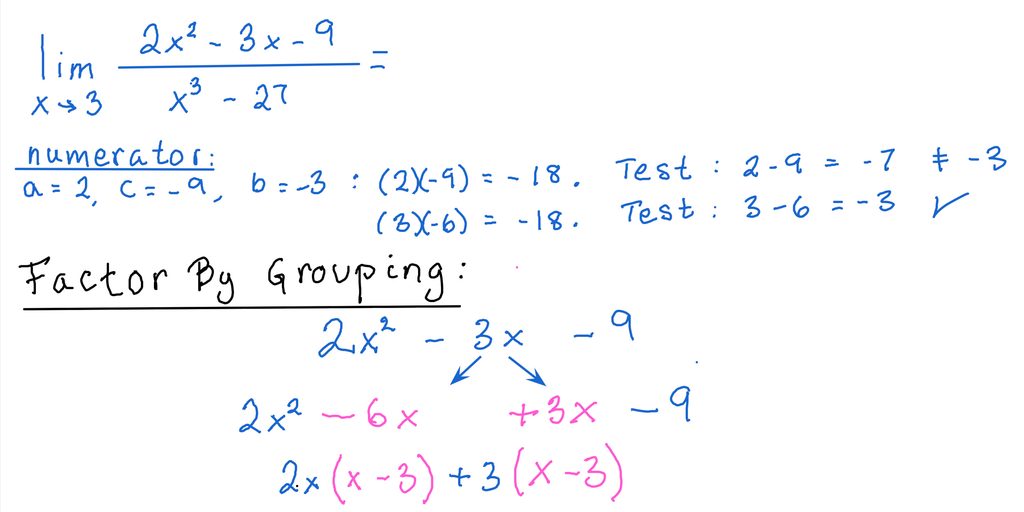
- The numerator is of the quadratic form : , where certain factors of and where these factors add up to b. For , and Notice that this is not b in example 1. So ask yourself, what other two factors of -18 adds up to -3 ?
- We have also , but However is also -18 and !! So these are our factors of b.
- To factor the numerator we here must use the technique Factor by Grouping. Recall from your algebra that Factor by Grouping involves separating bx into the two separate terms that are the factors adding up to b.
In the figure below (figure 2), I go over in detail to remind you of how to factor by grouping. Look at, study, and recopy this figure.
STEP 2)
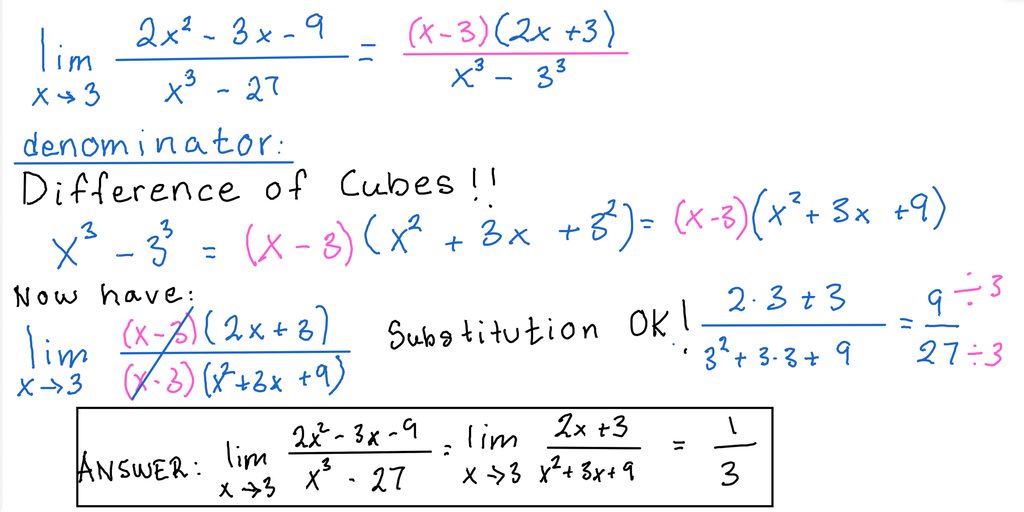
- Observe that the denominator is a difference of cubes: )
- When applying the formula for difference of cubes to our problem we get:
We now have a factor of (x-3) in both numerator and denominator that can be neatly eliminated! And we’re left within the denominator. Since these are all positive terms and the limit is a positive integer, the limit can now be evaluated by direct substitution due to the fact that the threat of denominator adding up to zero, no longer exists. See the solution in figure 3.
Identify when to use Factoring
As you probably noticed with the example above, both the numerator and denominator are in the form of a Polynomial. This is usually a strong indication that you should try to do straightforward factoring and hope to eliminate the culprit :).
Remember that the general form of a polynomial P(x) is $$P(x) = a_{n}x^{n} + a_{n-1}x^{n-1} + a_{n-2}x^{n-2} + … a_{n-m}x^{n-m} + a_{n-n}x^{n-n}$$
$$P(x) = a_{n}x^{n} + a_{n-1}x^{n-1} + a_{n-2}x^{n-2} + … a_{1}x^{1} + a_{0}x^{0}$$
where is the respective coefficient for each of the x variables in descending power, and since is the constant term. The power n is an integer and greater or equal to zero. So for rational functions of ‘polys’ of the form , for some limits A and B we have:
$$ \lim_{x\to a} \frac{P(x)}{Q(x)} = \frac{A}{B}, $$
and the steps to find the limit are:
- Factor to eliminate a common factor in the denominator.
- If denominator can be modified or cancelled so the restriction is eliminated, use direct substitution to find the limit.
- If you have factored and cancelled as much as you can, and there’s still a restriction that hinders the function to reach the limit, the limit Does Not Exist (DNE)
It must be noted that not all rational functions can be reduced, because the limit simply doesn’t exist at the given value the limit approaches. Also, even though we here used a fairly simple factoring method, you have previously learned many different ways to factor, like completing the square and using long-division. All these methods are actually fair game by your AP high-school teacher or college professor to randomly use on a test. However, most of the time it’s straightforward factoring. Still, I highly recommend that you spend some time memorizing the factoring rules you learned in your algebra classes. If you need a good review, then please read the article ‘Preparing for your first Calculus Class’ (to be published August 22, 2026), which covers the essential factoring techniques among other important concepts (link to blog).
Applying the Conjugate as the algebraic method
If you encounter a problem containing any kind of radicals, like if a term or one of the terms in the numerator or denominator is a square-root. Then chances are that you need to invoke the method of multiplying with the conjugate. As a short review: A conjugate to an expression containing two terms, for example (), is an expression with the same terms, but with opposite sign of the second term, so the conjugate here is: . Thus () and are a conjugate pair. Multiplying these two expressions results in:
$$(\sqrt{x} + 5)(\sqrt{x} – 5) = (\sqrt{x})^2 – (5\sqrt{x})+ (5\sqrt{x})\; – 5^2 = x – 25$$
$$\text{and}$$
$$(5 + \sqrt{x})(5 – \sqrt{x}) = 5^2 – (5\sqrt{x})+ (5\sqrt{x})\;- (\sqrt{x})^2 = 25 – x$$
where the two inner terms always cancels after distributing the factors. This might remind you of difference of squares, which are indeed conjugates: . The above conjugates are simple expressions, but conjugates can be much more complicated looking, as with these examples:
$$\left(\sqrt{(x^2 +8)} – 3\right) \leftrightarrow \left(\sqrt{(x^2 +8)} + 3\right)$$
$$\text{ or }$$
$$\left(19 + \sqrt{(x + 11)} \right) \leftrightarrow \left(19 – \sqrt{(x + 11)}\right)$$
What is important to realize is that the conjugate is an application of an algebraic identity. For cube roots and higher-order radicals, similar algebraic identities exist, although they involve more complicated factors than a simple conjugate. The underlying goal remains the same: eliminate or simplify the radical so the limit can be evaluated, as can be seen in the below examples.
Identify when to Multiply with the Conjugate.
Consider the following two examples:
$$\lim_{x \to 0}\frac{\sqrt{(x^2 + 16)} – 4}{x^2}\;\; \text{(Example 2)}$$ and $$\lim_{x \to -1}\frac{\sqrt{(x^2 + 8)} – 3}{x+1} \;\; \text{(Example 3)}$$
They both contain square-roots, and therefore a big hint is to create a common factor by multiplying with the conjugate. So how do we do that? We multiply with the conjugate of the expression containing the square-root in both numerator and the denominator. Remember that when multiply both the numerator and denominator by the same nonzero quantity (basically a form of 1) the value of the expression remains unchanged. But first look at what happens when we do direct substitution.
If you do direct substitution to limit problem Example 2, we notice that obviously we get a zero in the denominator, however we get a zero in the numerator as well:
$$ \lim_{x \to 0}\frac{\sqrt{(x^2 + 16)} – 4}{x^2} \to \lim_{x \to 0}\frac{\sqrt{(0^2 + 16)} – 4}{0^2} \to \lim_{x \to 0}\frac{\sqrt{(16)} – 4}{0} \to\lim_{x \to 0}\frac{4 – 4}{0} = \frac{0}{0}$$
What we get here is called an indeterminate form and later on in your Calculus course when you learn about derivatives, this will be very important because we can under certain circumstances get a real answer! Your professor may turn to the class at this moment and start talking about this concept ( this is quite a common example ) however stay focused with your thoughts because right here, applying the conjugate method is the right course of action!
The steps are:
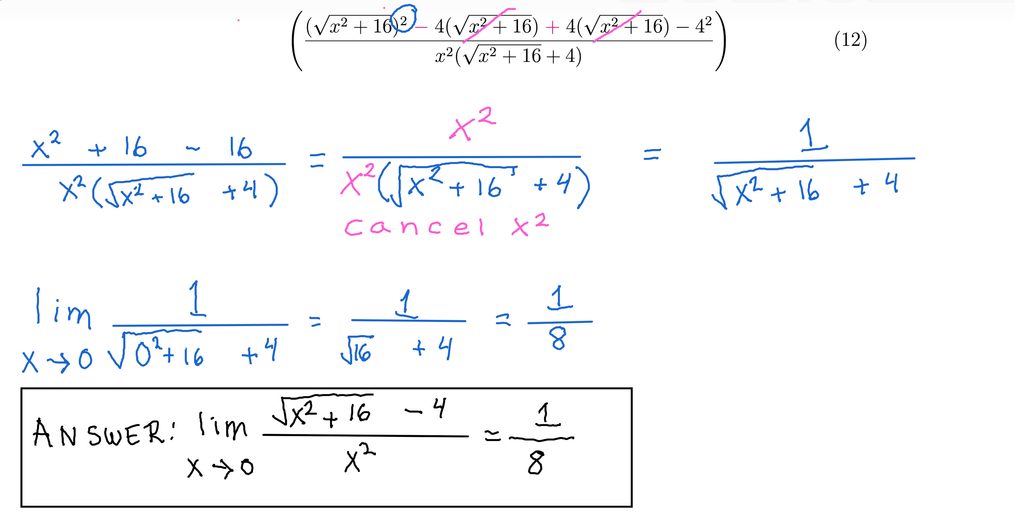
1) Multiply numerator and denominator by the conjugate:
$$ \left ( \frac{\sqrt{(x^2 + 16)} \; \color{red}{-}\; 4}{x^2}\right) \left (\frac{\sqrt{(x^2 + 16)}\; \color{red}{+}\; 4}{\sqrt{(x^2 + 16)}\; \color{red}{+}\;4}\right ) $$
2) Distribute numerator first, using the standard FOIL method:
$$\left ( \frac{ (\sqrt{(x^2 + 16)})^2 \; \color{red}{-}\; 4(\sqrt{(x^2 + 16)}) \; \color{red}{+}\; 4(\sqrt{(x^2 + 16)}) -4^2 }{x^2(\sqrt{(x^2 + 16)} + 4)}\right )$$
3) Simplify as much as you can.
4) Finally, apply direct substitution. See details in figure 4 below.
We will now apply the same steps to limit problem Example 3, which is slightly more complicated to reduce, and that makes it an excellent example.
If you try direct substitution the denominator becomes a zero, so we must apply the conjugate of () and try to reduce. One thing to notice, besides the extra constant term in the denominator, is that there is no ‘relationship’ between the 8 and the 3, meaning compared to the previous problem where you know that the . This is a good indication that you need to be extra careful during the simplification process.
1) Multiply numerator and denominator by the conjugate:
$$\left( \frac{\sqrt{(x^2 + 8)} – 3}{x+1}\right) \left( \frac{\sqrt{(x^2 + 8)} +3}{\sqrt{(x^2 + 8)} +3}\right)$$
2) Distribute numerator and denominator separately, using the standard FOIL method:
$$\frac{(\sqrt{(x^2 + 8)})^2 \color{red}{-} 3 \sqrt{(x^2 + 8)} \color{red}{+}3\sqrt{(x^2 + 8)}-9}{(x\sqrt{(x^2 + 8)}) + 3x + (1\sqrt{(x^2 + 8)}) +3}$$
Although this is correctly distributed and the inner terms in the numerator cancels, this looks like a complete mess!! BUT, as figure 5 shows, there’s an algebraic technique hiding in the denominator that we can use 🙂
3) Simplify as much as you can by using your awesome cleverness.
4) Finally, apply direct substitution. See details in figure5 below and recopy the problem.
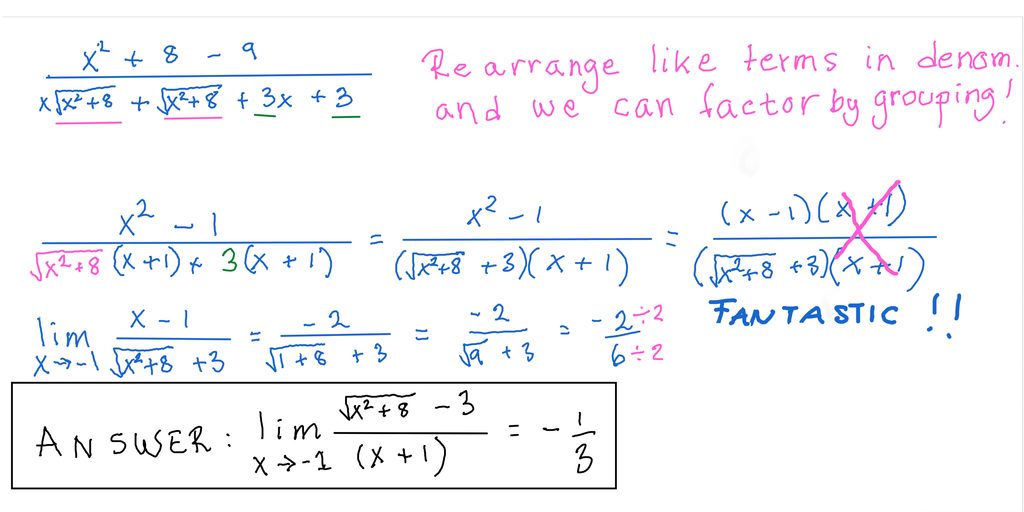
So, even though this required a combination of algebraic techniques, the function could be simplified and this limit could be found. As demonstrated with this example, it is really important to have all your mathematical tools from previous courses ready to use at any moment.
It is quite valuable to graph these limits as well, even if it’s not required, to get a deeper understanding. Of course, when you are having a test and are on a time constraint, then spending extra time on graphing is not recommended if it’s not needed. But for your homework you definitely should. I typically use the open source software LibreOffice Calc ( LibreOffice is an open-source office suite and can be downloaded from https://www.libreoffice.org), but your can also use Google Sheets or Excel. Using a spreadsheet will require you to define an appropriate interval for your \(x\) values. You can always use a calculator like TI – 86 or higher, or use an online graphing software like Desmos (https://www.desmos.com/calculator). However, I find that students understand better and think about the problem deeper when they construct the graph themselves rather than simply entering the function into graphing software. Best is of course to graph ‘by hand’.
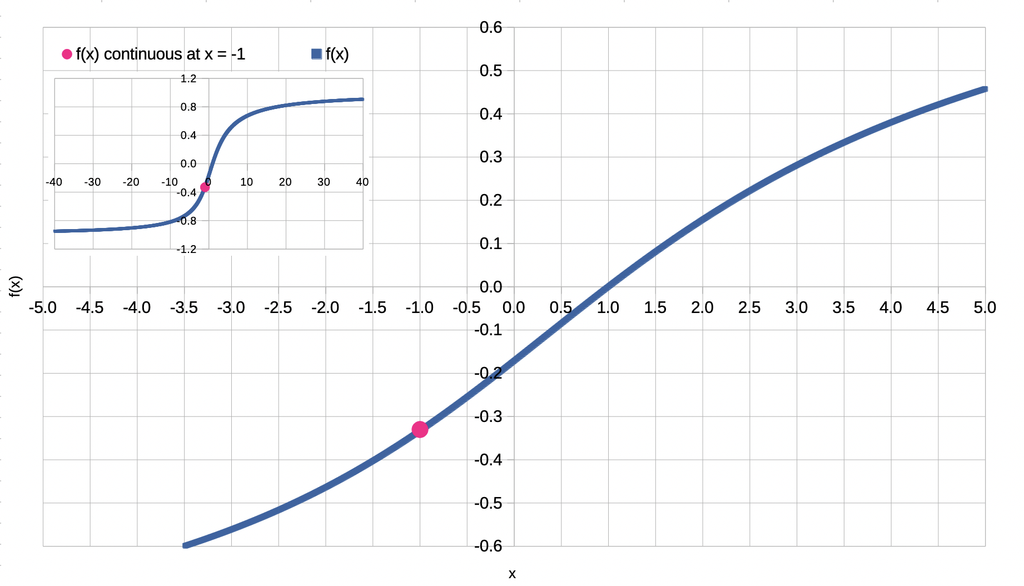
\((-\infty, \infty)\). The inset shows the graph over a larger interval. Here we get an understanding that even if the limit asked for what happens when \(x\to-1\), we see that \(f(x) \to – 1/3\).
Conclusion
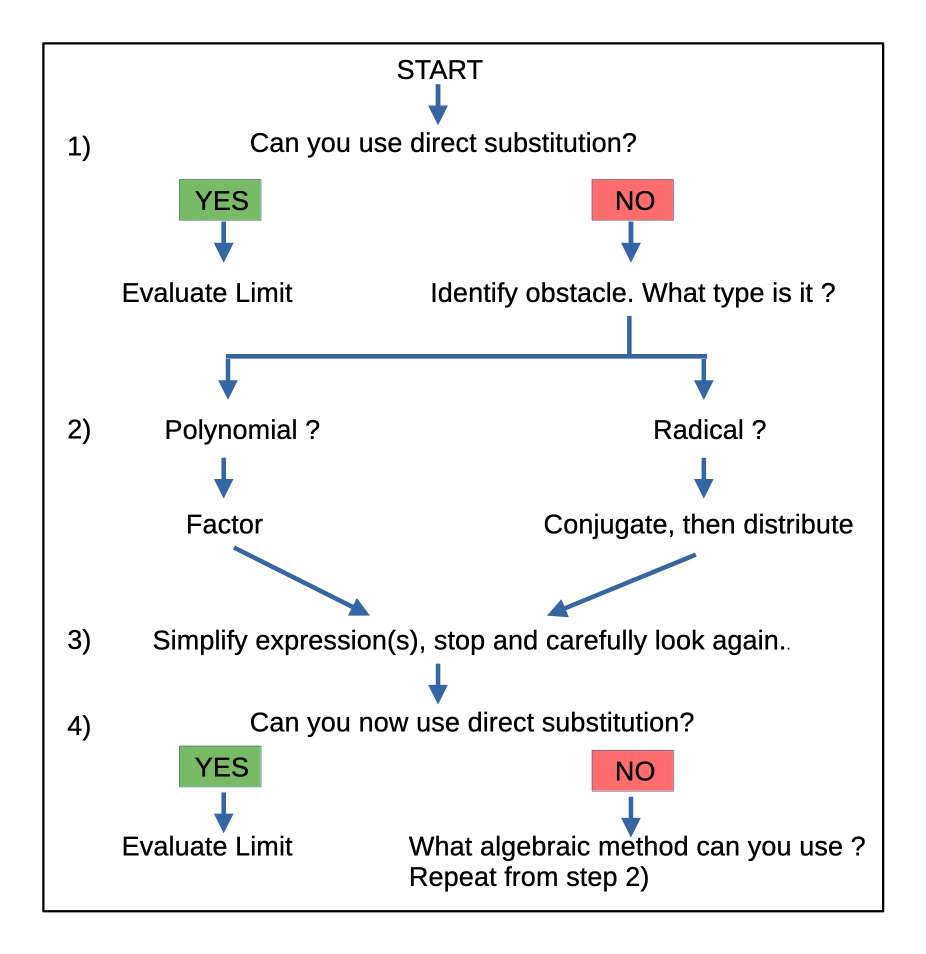
Great job of following along and reading this article so far! The key to evaluate any limit (or other math problems) is to be very methodical and stop and ponder a bit between the steps ‘what is it that I should do next …?‘ . In figure 7 you’ll see a ‘thinking’ roadmap that is good to follow when you encounter the type of limits we have discussed here.
Cube roots and Higher Order Radicals.
Before I finish, I’d like to just briefly go over how to deal with higher order radicals. By definition, pairs containing cube roots or higher order radicals with opposite signs are strictly speaking no longer conjugates, but the same reasoning and algebraic idea applies. Let’s make the term with the square root in problem Example 3, a cubic term. Besides changing the sign of the of the pair you are multiplying with, you need to make sure that the power of the radicands (i.e. terms inside the radical) is to the second power, so when these radicals are multiplied in the numerator the radicand is to the third power, which cancels the cube root. Otherwise the overall strategy remains the same in terms of the steps you will use to solve the limit. Inner terms cancels in the numerator and you still need to use factor by grouping in the denominator.
$$
\left( \frac{\sqrt[3]{(x^2 + 8)} – 3}{x+1}\right) \left( \frac{\sqrt[3]{(x^2 + 8)^2} +3}{\sqrt[3]{(x^2 + 8)^2} +3}\right)
$$
$$\frac{(\sqrt[3]{(x^2 + 8)})^3 \color{red}{-} 3 \sqrt[3]{(x^2 + 8)} \color{red}{+}3\sqrt[3]{(x^2 + 8)}-9}{(x\sqrt[3]{(x^2 + 8)^2}) + (1\sqrt[3]{(x^2 + 8)^2}) + 3x +3}$$
Remember that the hardest part of many limit problems isn’t the algebra—it’s recognizing which algebraic tool to use.
Good luck with your calculus and I’d like to know how you did so do please leave a comment by simply clicking ‘comment’. Also, always try to solve as many problems as you can, especially the sections and concepts you are struggling with!
Good Luck and Thanks for reading!
——————–
Miss Liz
M.Sc. Physics.
B.S. Astrophysics.